Monday, March 21, 2011

Shooting the Moon

"I'm in the wrong place!" I thought angrily. How could it be that after hours of preparation my photo of the "super moon" was probably not going to happen as planned? The modern technology I had employed to try to capture the best shot had failed me.

I started the day with a list of locations in Rochester that I thought might be good for shooting the moon. Each one was previewed and mapped out with Google Earth. The KML file with the locations was transferred to my phone and Dan O. and I went to each site in turn assessing it for a suitable foreground with the proper orientation. The first sign of trouble happened early when the phone's compass and sky map applications failed to calibrate properly. In the morning I had determined that the moon would rise at about ten degrees south of east but since the compass wasn't working it was difficult to visualize exactly where that was.

After visiting all the locations only one seemed to hold any promise, and we weren't really happy with it. In the end we decided to scrap the urban concept and photograph in Mendon Ponds Park. That afternoon I spent another two hours with Google Earth trying to find the most likely locations that fit our criteria: some sort of vegetation or other detail in the immediate foreground, water in the middle ground (but not a vast expanse) and hillside trees in the distance. Several places along the south west edge of Hundred Acre Pond seemed our best bet.
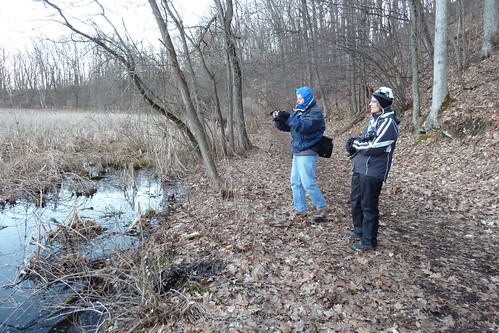
Scouting Super Moon Locations
Dan and Sarah at the edge of Hundred Acre Pond in Mendon Ponds Park.
Dan, Sarah and I got to the park about an hour before moonrise and geared up to scout out locations. Along the way we were distracted by four deer running just uphill of us across the West Esker and a beaver swimming along the edge of the pond. After surveying the area I decided to set up my tripod at the narrow channel that divides Hundred Acre Pond and Deep Pond. Dan decided to try his luck further back along the edge of the pond.

Here I was waiting and wondering when the moon would finally rise above the small hill in the east when I realized that there was a definite glow about 20 degrees to the right from where, based on my jittery phone compass, I had expected the moon to rise. The view in that direction was blocked by dense tree growth. I grabbed up my tripod, Sarah got the pack and we hustled back to where I thought I could get a better shot, but it was too late. The moon was already off the horizon there and I had no foreground detail at all, I might as well have taken pictures of the moon from just outside my front door.

I worked my way over to Dan who had managed to find a location with cattails, water, and distant trees. As I muttered about my poor photographic skills I started to look around (always a good idea for a photographer) and I had a sudden revelation: with the bright light I could make some landscape photographs illuminated by the moonlight and with stars overhead.
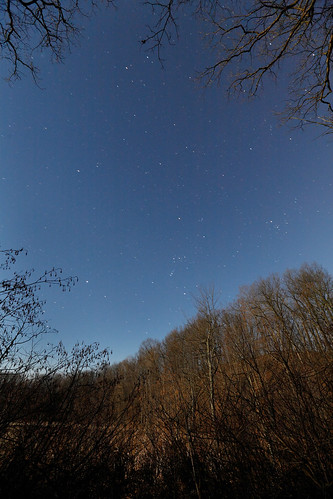
Hundred Acre Pond: Orion
Constellation Orion over Mendon Ponds Park lit by "super moon" light.
After a few experimental exposures I began photographing the pond with the Big Dipper hanging directly above. Right away I felt that I had something good here, maybe even better than a photo of the moon itself. After an hour or so of shooting with one final stop for a photo of Orion striding above the pond as though in pursuit of the deer we saw earlier, we piled our gear into the car and headed off to dinner. By the end it turned out to be a very satisfying evening of photography, nature, and friends. Next time though I'm bringing some ancient technology - a compass and a map.

Sunday, January 23, 2011

The Shadows Will Be Behind You if You Walk Into the Light

"Darkness cannot drive out darkness; only light can do that. Hate cannot drive out hate; only love can do that."
- Martin Luther King Jr.

With this morning's news of government employee malfeasance[1] and the shamelessly brazen behavior of elected officials[2] it would be easy to give free rein to winter darkness and the cynical feelings it breeds. After a brief renewal of my ongoing internal struggle with despair over the human condition I decided that rather than allowing small people to waste my time and attention I would concentrate it instead on someone who did something positive and improved the world.

Tom White was a founder and backer of Partners In Health. He died earlier this month. His friend Paul Farmer gave a wonderful eulogy that I encourage you to read in full[3].

Tom was a great man by conventional criteria but mistrusted, most of his life, these criteria. He was, as has been noted far and wide, a successful businessman who mistrusted the trappings of wealth and served as a model for spreading it around. He was a Harvard graduate who by his own account didn’t study much; a decorated soldier who was at heart a pacifist; a successful businessman who relied on generosity and trust in all his dealings; a devout Catholic who acknowledged crises of faith and knew the sharp limitations of all human institutions; and a family man with a large family here in this city and, thanks to his family’s willingness to share him, scattered throughout the wide world. . . Nothing made him happier than fixing a problem, but there were some he could not fix, and he confronted these too. When he could not save a life, or ease a loved one’s pain, he was still left with his ministry of showing up.
One of the many examples I should learn from Tom White's life is that even if I can't solve a problem I can still show up. Even if the situation is difficult, or it's awkward and I don't know what to do, I guess I can hold a hand at least as as well as the next person and be there.

1 - Democrat and Chronicle (David Damelio charged $3,988 at N.Y.C. strip club)
2 - Democrat and Chronicle (State Sen. James Alesi suing over fall at unfinished home)
3 - Partners in Health (He restored our faith in faith itself.)

Thursday, December 30, 2010

Kodachrome and Analog Obsolescence

Perhaps you remember or have heard of film, specifically the film called Kodachrome? Well tomorrow is the last day to get it developed, and you'll need to get it to Dwayne's Photo Lab in Kansas to have it done. Starting January 1, 2011 any pictures taken on undeveloped Kodachrome film will be lost forever. This got me thinking about the angst over digital storage, when file formats become obsolete and unsupported the information in them will effectively disappear. This is the first time I recall that something similar is happening to photographic analog storage.

Black and white film or other color film has always been fairly easy to develop in a small darkroom at home but the Kodachrome development process is complex and requires very strict process control. There has never been a Kodachrome home development kit, and there never will be. In this way undeveloped Kodachrome film is like digital media: it requires a complex infrastructure to retrieve the image data. However unlike undeveloped film (with its invisible latent image1) developed Kodachrome film is like any other photographic film, all that's needed to "retrieve" the image data is light. Magnifying the image helps too.

Of course there are many photographic capture processes that are no longer available. The difference between all those other processes and Kodachrome is popularity. Kodachrome was the first color process widely adopted by both professionals and consumers. It was also the primary media for capturing color images for decades. Millions, if not billions, of rolls of film were sold and I am fairly certain that thousands of rolls that were exposed but never developed exist around the world.

The well-known "Zapruder Film" of the Kennedy assassination was taken with a movie camera loaded with Kodachrome2. If there is any undiscovered footage taken on that day in that location it was also probably captured on Kodachrome film. If such a film is found in the future it will be difficult, if not impossible, to see those images. And there is no chance of any such film being discovered accidentally simply because a roll of film was found in a drawer and developed.

There were earlier commercially viable color processes, but none were as robust as Kodachrome. For example if you see any color film or photos taken during World War II you are more than likely looking at very early Kodachrome which was only available to the military. Widespread adoption by consumers started after the war giving Kodachrome a lifespan of about 65 years. Any photographs captured on it during that time, but undeveloped will effectively cease to exist in two days. For photographers I think there is one obvious lesson: make prints. Regardless of capture media, film3 or digital, you should print any images you want to be seen in the future. I acknowledge that prints can fail as well, either through physical damage or fading. But if you use good quality ink and paper and store them reasonably the prints have a chance of at least outlasting you. Just keep in mind that viewing prints doesn't require any complicated hardware or software, just light, and that's pretty much guaranteed to be abundantly available for the next five billion years.

1 - Encarta (http://encarta.msn.com/dictionary_1861693039/latent_image.html)
2 - I just assumed that it was, but here's a citation: Wikipedia (http://en.wikipedia.org/wiki/Zapruder_film)
3 - Yes I know there are a few of you still using transparency film and that you don't need prints to see them but almost all exposures these days are digital, and should be printed.

Monday, November 22, 2010

"We were very excited. . ."

". . .to see what you brought in to the show today. Where did you get this?

"I bought it at an estate sale."

"And how much did you pay?"

"Not much, a few dollars."

"Well a hundred years ago back at the beginning of the twenty first century, when disks like this could be had for a few pennies, pennies still existed then, digital photos could be stored on disks like this one. This disk happens to have the very best pictures of this noted photographer. Had you ever heard of him before?"

"No I hadn't."

"Well I'm not surprised most of his work was stored digitally and it was one of those pockets of information that was lost during the 'Great Data Conversion' of 2054. Unfortunately we don't have any of his pictures to show but according to accounts his pictures of evening landscapes have the most beautiful colors, like a Parrish painting. The composition and control of contrast in his photos are stunning though the digital screen images lack the punch of his prints. His photos of people from around the world increased their understanding of each other. He was a true master of the art but he rarely printed anything.

Now until recently we had a player for these disks but unfortunately it didn't survive being beamed here from Earth, a few of its atoms got scattered across space.

If you had brought in one of the few surviving prints made by this artist we'd be talking about some serious money right now. The disk does have a few condition issues -"

"We used to play with it as kids, rolling it down the stairs and such."

"OK, unfortunately with no way to actually view the pictures on it it doesn't have much appeal to collectors. What do you think it's worth?"

"Well I, I have no idea I've never had it appraised - er, no one has looked at it. That's why I brought it in."

"OK. Well after consulting with my colleagues, and we had quite a bit of discussion about this, I would estimate it's value to be about the same as the recycle value."

"And that would be?"

"Worthless."

"I'm sorry did you say priceless?"

No, worthless. The disk is authentic and the pictures are certainly stored on the disk but all the value is in the images, not in unviewable binary representations of them. But thanks so much for bringing this in, it was a real treat to see it. Thanks!"

Sunday, October 24, 2010

Backyard Autumn Reading and Bird Report

Having exhausted my tolerance for electronic distractions and finding that the air was warm and the sunlight had a golden quality that only happens when it is filtered through autumn leaves I decided to spend late afternoon outside with a book. I completed the scene with a fire, but since it had rained the night before I built a damp steaming blaze then got down to reading.

At a quarter to five a flock of Robins suddenly arrived in the yard; they worked their way from one side to the other in a rough line. Making a loud rustling noise all out of proportion to their diminutive size they turned leaves over and charged one another in their search for dinner.

A second avian wave commenced about fifteen minutes later. Chickadees, White Breasted Nuthatches and a pair of Cardinals arrived at the back feeder. For a short time the female cardinal defended the feeder against all interlopers until she had eaten her fill and flew off. Then the chickadees and nuthatches, with the sound of fluttering wings and quiet chirps, made repeated trips, each time taking a single seed in their beaks then flying to a nearby tree. All of this activity was interesting in itself but I became part of the act when one chickadee flew from the feeder to the roof of the house, then the table next to me, then the top of the baseball hat I was wearing. I imagined that I would be an amusing sight to any neighbor that looked out and saw me reading my book with a bird perched on my head. After a few moments it flew off.

For ten minutes or so the backyard's airspace was busier than a major international airport with departures and arrivals. Eventually the birds' appetites were sated with only a few latecomers appearing sporadically. I waited a little while to let the fire burn down then decided it was time to forage for my own dinner.

Friday, August 20, 2010

Rant About Buying a Photo Backpack

I'm convinced there is no perfect photo backpack, only almost-but-not-quite-right packs. This explains my growing collection of photo-gear lugging-gear. Each backpack seems to have at least one flaw that prevents it from achieving backpack nirvana. Also I'm not into the giant packs, I really need about 715 cubic inches of space (W11" x D5" x H13") plus a pocket for a laptop. I'm using the pack to transport my photo equipment by car or plane; on arrival I'll unload chargers, cables, laptop, etc. to use it for an eight-to-ten-hour day of shooting and I'll be carrying it for about a third of that time.

So I'm looking for a new backpack and have decided this is what manufacturers need to show their customers (people doing online video reviews should do the same):

  • The very first photo should be of someone who is 5' 10" in height wearing the backpack so I can get a feel for the size. Printing the exterior dimensions with a photo of the pack sitting on a white seamless background isn't good enough.
  • The next photo should show the same person wearing the pack with the waist straps in use. Far too many packs have useless waist straps because they are too high above my hips (and I'm average height).
  • While you're at it hook up the sternum strap.
  • Are the eyelets of the zippers big enough so that a TSA sanctioned lock will fit through them to secure the pack?
  • Show the pack with a tripod that extends to 60" (without the centerpost being raised) clipped into place. Three or four leg sections, your choice.
Of course show the obligatory pack laden with glittering lenses picture, but everyone can do that, I mean, it is a photo backpack right? And if it isn't obvious the features mentioned in the list above are almost required for me to buy the pack (but I'll probably compromise, see paragraph one above about fatal flaws). Lastly, if you want to delight your customers ship each pack with a pocket for a water bottle, and a bottle, that would be perfect!

Monday, August 9, 2010

Economy

In the not so distant past when the only food available was what was in season the act of canning food in the summer for use in the winter was probably undertaken as a necessary chore. I imagine that most people today, if they are aware of canning at all, think of it as pointless work since almost all fruits and vegetables are available year round. But there is a deep satisfaction that comes from making food (preferably from produce grown in your own garden) and storing it away for the future.
Jars of pizza sauce cooling.
Jars of pizza sauce cooling. Happiness and contentment.
Canning is not an easy task, there is preparation to be done including picking, washing, cutting, and maybe cooking. There is lively discussion, "Is that Basil or Parsley?" "Should the water be boiling when the jars go in, or just simmering?" And finally waiting for that tell-tale pop from each lid that indicates a jar is sealed, and that all the work that went into it was successful. The best part about canning is the feeling of satisfaction. Satisfaction that you have filled a basic need. Satisfaction that in the dark and cold of February you can open a jar of pears that you canned in the fall and those pears remind you that spring must come again and it is not so far away.

When the canning is finished and the equipment washed there is a contentment and peacefulness found in contemplating the jars cooling on the counter. Canning is a positive act that engages the best human characteristics: nurturing a garden, caring for living beings, patience as the plants grow, skilled work processing the produce in the jars, storing the food for the future, and finally enjoying the hard work when a jar is opened. In closing I must thank my parents for my introduction to canning; even the memory of those days when I came home from school and the house was filled with an almost over-powering smell of vinegar because relish was being canned has not been enough to prevent me from doing the same (canning that is, not making relish).